TL;DR — We investigate cross-domain memory transfer for coding agents and show that leveraging a unified memory pool from heterogeneous benchmarks improves average performance by 3.7%. Abstraction is the key: high-level insights generalize across domains while low-level traces induce negative transfer.
Overview
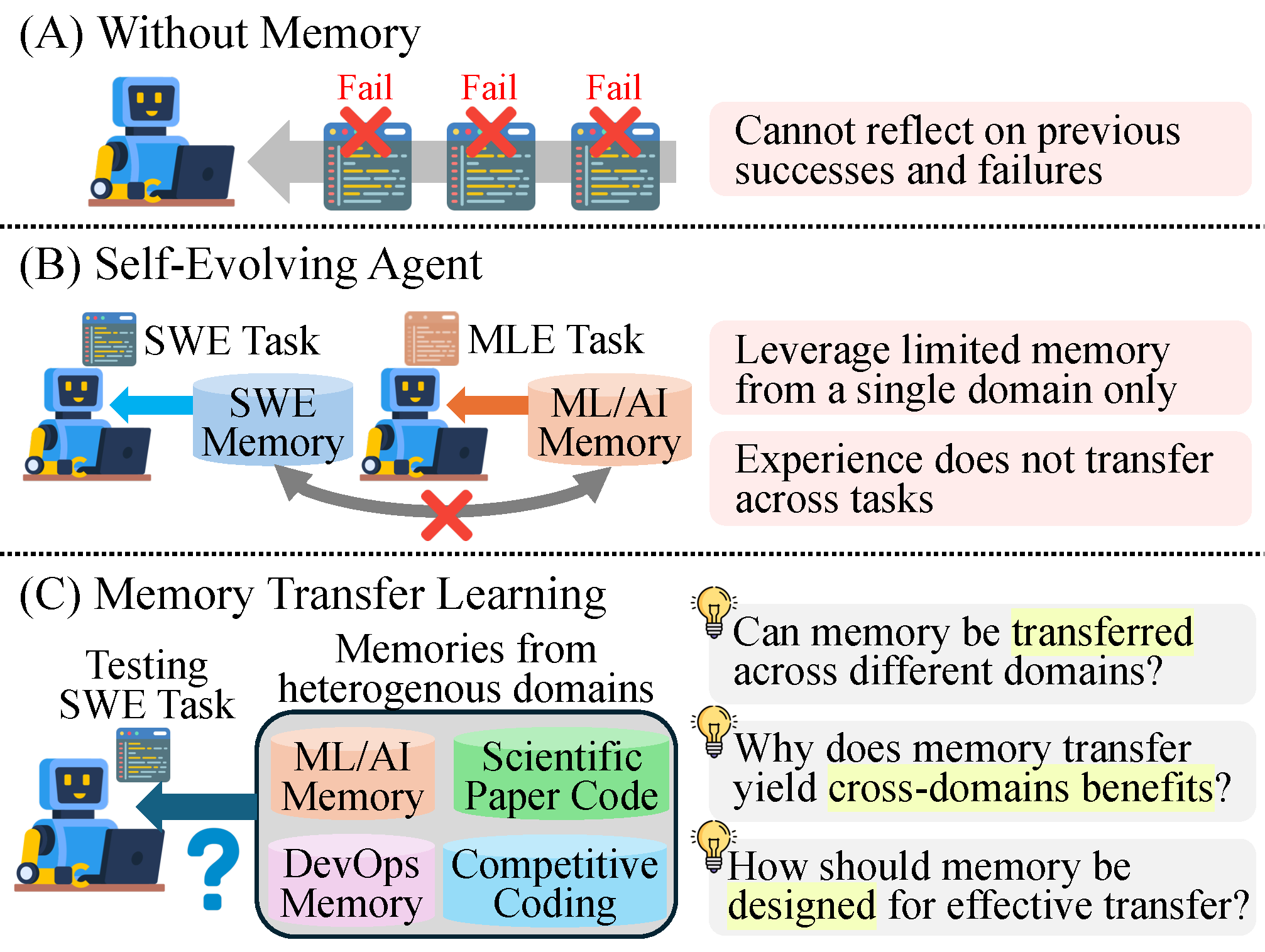
Existing self-evolving coding agents restrict memory usage to the same benchmark (B).
We propose Memory Transfer Learning (C), which leverages a unified memory pool from
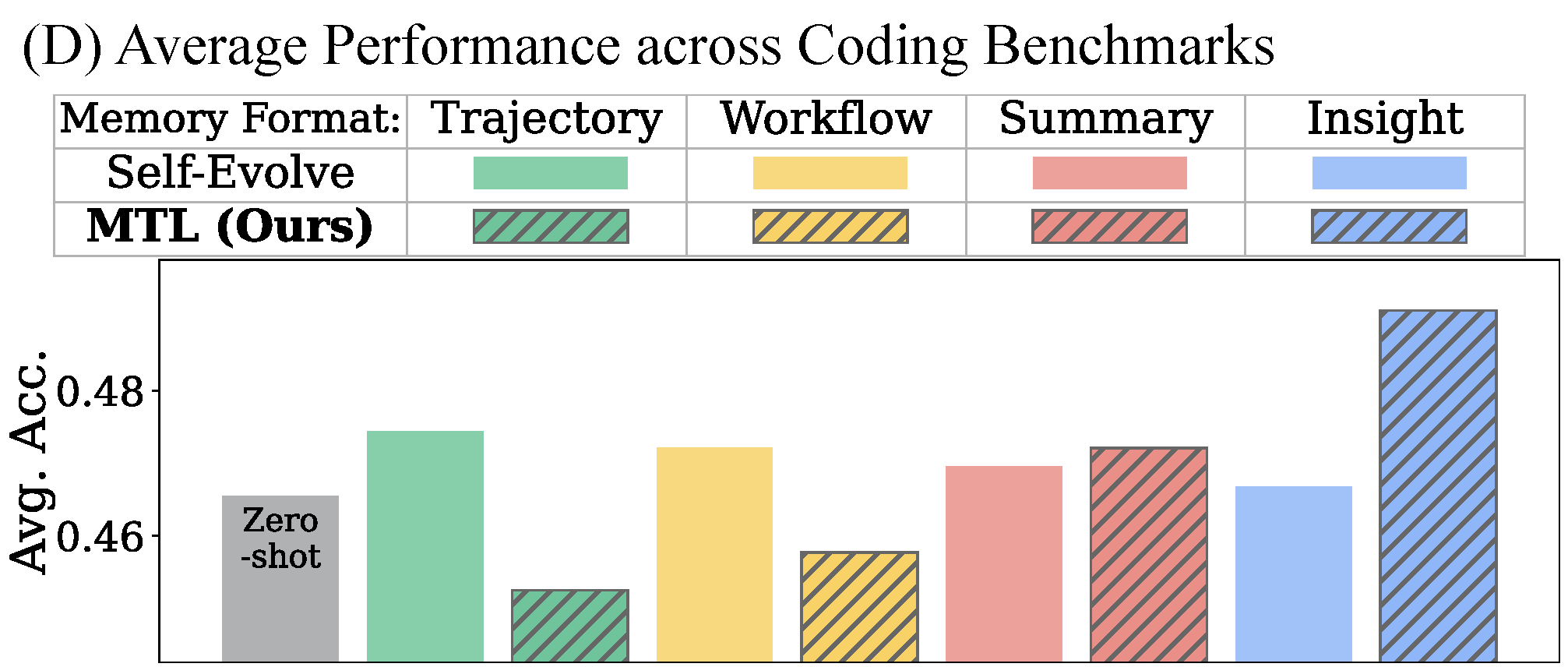
heterogeneous domains, and show it outperforms domain-restricted approaches (D).
(A) Memory-less agents cannot reflect on past experience.
(B) Self-evolving agents leverage memory but only within a single domain.
(C) MTL leverages a unified memory pool from heterogeneous coding tasks.
(D) MTL (hatched bars) consistently outperforms self-evolving agents across all four memory formats.
RQ1
Does memory from heterogeneous domains improve the performance of coding agents?
RQ2
Why do transferred memories yield benefits across different domains?
RQ3
Which factors in memory transfer learning most influence transfer effectiveness?
Abstract
Memory-based self-evolution has emerged as a promising paradigm for coding agents. However, existing approaches typically restrict memory utilization to homogeneous task domains, failing to leverage the shared infrastructural foundations, such as runtime environments and programming languages, that exist across diverse real-world coding problems.
To address this limitation, we investigate Memory Transfer Learning (MTL) by harnessing a unified memory pool from heterogeneous domains. We evaluate performance across 6 coding benchmarks using four memory representations, ranging from concrete traces to abstract insights.
Our experiments demonstrate that cross-domain memory improves average performance by 3.7%, primarily by transferring meta-knowledge, such as validation routines, rather than task-specific code.
Importantly, we find that abstraction dictates transferability; high-level insights generalize well, whereas low-level traces often induce negative transfer due to excessive specificity.
Furthermore, we show that transfer effectiveness scales with the size of the memory pool, and memory can be transferred even between different models.
Our work establishes empirical design principles for expanding memory utilization beyond single-domain silos.
Method
Memory Representations
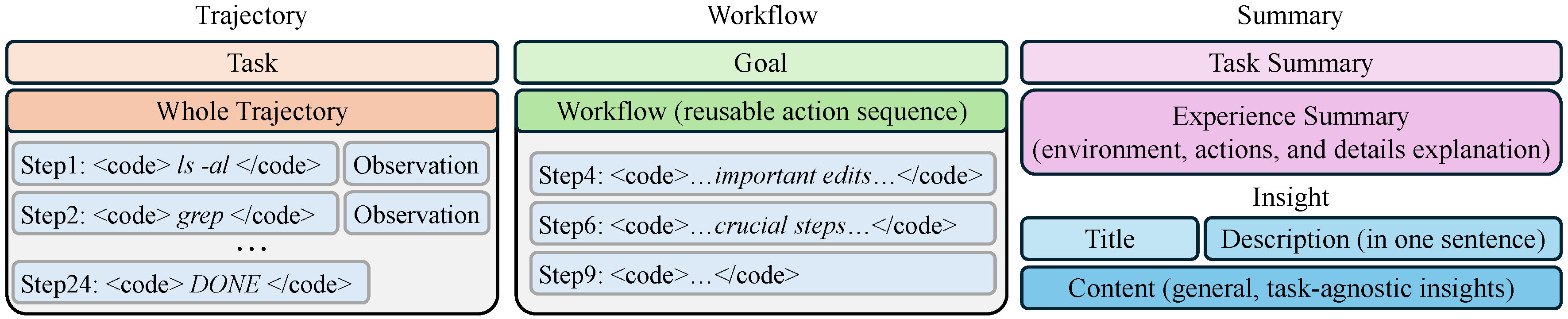
We construct four types of memory representations from agent trajectories, spanning a
spectrum from concrete low-level traces to abstract high-level insights.
Figure 2. Four memory formats used in this work.
Trajectory retains all raw commands and observations.
Workflow extracts reusable action sequences.
Summary provides a natural-language account of successes and failures.
Insight distills generalizable principles without task-specific details.
🔍
Trajectory
Concatenates all agent commands and execution results without reasoning sentences. Contains full task-solving detail including failed steps.
⚙️
Workflow
Extracts a reusable goal-oriented workflow from the trajectory — a goal statement plus a subset of meaningful actions.
📝
Summary
Prompts an LLM to summarize the task, environment, actions, and an analysis of why the inference succeeded or failed.
💡
Insight
Generalizable principles with title, description, and content — written to be task-agnostic for effective cross-domain transfer.
Memory Retrieval Pipeline
Memories from all benchmarks except the target benchmark are pooled and indexed
with text embeddings. At inference time, the top-N memories are retrieved via
cosine similarity and injected into the agent's system prompt.
1
Memory Generation
Run the agent across all benchmarks. Use an LLM judge to assess success/failure, then generate all four memory types from each trajectory.
→
2
Pool Construction
Merge memories from all benchmarks except the target. Index each memory using text-embedding-3-small for fast retrieval.
→
3
Retrieval & Inference
For each query, retrieve the top-3 most similar memories and prepend them to the coding agent's system prompt before inference.
Results
Main Results across 6 Benchmarks
MTL consistently improves performance across all six coding benchmarks.
Insight memories achieve the best results, with gains of up to 8.3% on individual benchmarks.
Table 1. Pass@3 scores across 6 coding benchmarks under zero-shot and Memory Transfer Learning settings with four memory formats (T=Trajectory, W=Workflow, S=Summary, I=Insight). MTL with Insight achieves a +3.7% average gain over zero-shot.
Method
LiveCodeBenchv6
Aider-Polyglot
SWEBench-Verified
TerminalBench2
ReplicationBench
MLGym-Bench
Avg.
GPT-5-mini
Zero-Shot
0.910
0.470
0.730
0.315
0.111
0.667
0.523
MTL (T)
0.940
0.490
0.770
0.270
0.122
0.583
0.534
MTL (W)
0.920
0.470
0.770
0.348
0.111
0.583
0.538
MTL (S)
0.930
0.460
0.760
0.371
0.133
0.667
0.546
MTL (I)
0.930
0.470
0.770
0.360
0.189
0.750
0.560
Δ
+2.0%
0.0%
+4.0%
+4.5%
+7.8%
+8.3%
+3.7%
DeepSeek V3.2
Zero-Shot
0.930
0.590
0.530
0.337
0.267
0.583
0.542
MTL (I)
0.940
0.580
0.590
0.393
0.278
0.667
0.568
Δ
+1.0%
−1.0%
+6.0%
+5.6%
+1.1%
+8.3%
+2.6%
Qwen3-Coder-480B-A35B-Instruct
Zero-Shot
0.800
0.460
0.590
0.292
0.211
0.583
0.483
MTL (I)
0.810
0.480
0.620
0.326
0.211
0.583
0.501
Δ
+1.0%
+2.0%
+3.0%
+3.4%
0.0%
0.0%
+1.8%
Comparison with Self-Evolving Baselines
MTL outperforms ReasoningBank (+2.9%) and AgentKB (+1.7%) with only 431 memories
— far fewer than AgentKB's 5.8k memories — demonstrating both effectiveness and efficiency.
Table 2. Pass@3 comparison with self-evolving methods on three benchmarks. MTL outperforms both baselines using only 431 memories vs. AgentKB's 5,899.
Method
#Memories
LiveCodeBenchv6
SWEBench-Verified
ReplicationBench
Avg.
Zero-Shot
—
0.910
0.730
0.111
0.584
ReasoningBank
97
0.920
0.750
0.133
0.601
AgentKB
5,899
0.920
0.720
0.200
0.613
MTL (Ours)
431
0.930
0.770
0.189
0.630
Finding 1
Memory Transfer Learning significantly improves coding agent performance and outperforms
self-evolving methods in both effectiveness and efficiency.
Analysis
Why Does Memory Transfer Work?
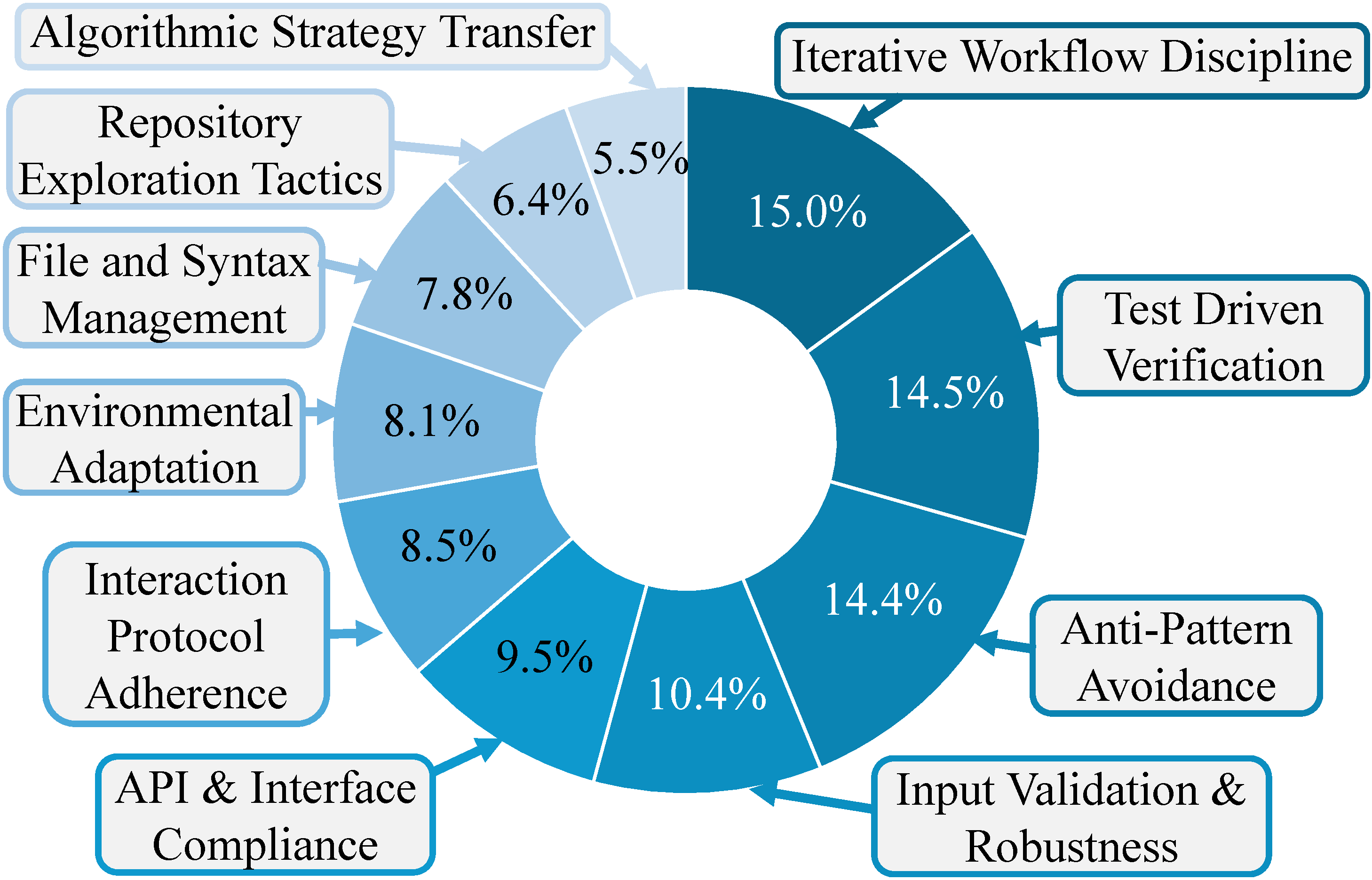
We collect trajectories where zero-shot fails but MTL with Insight succeeds and analyze
how transferred memory contributes to success.
Figure 4. Categorization of how transferred memory enables successful
task completion. Meta-knowledge (structured workflows, constraint guardrails, safe editing
practices) accounts for the vast majority of gains. Algorithmic strategy transfer is rare
(5.5%).
Case Study: Zero-Shot vs. Memory Transfer Learning
An Insight memory generated from LiveCodeBench provides inline test validation guidance,
enabling the agent to succeed on an SWE-Bench task where zero-shot fails.
Zero-Shot Fail
MTL with Insight Success
Memory
(No memory)
Memory Item 2 — From LiveCodeBench Title: Create quick self-contained tests using an inline Python here-doc to validate fixes
Description: When making small code fixes, write a minimal test that covers the exact scenario described in the problem...
Content: Set up a short battery of tests that cover the specific edge cases mentioned, run them inline with a Python here-doc to confirm the fix works before submitting...
Reasoning
I will modify django/db/models/aggregates.py to raise a FieldError when an Aggregate's source expression contains a window clause. This prevents creating an aggregate over a window expression...
I will use Memory Item 2 (use an inline Python here-doc for safe, atomic edits and quick verification) to modify django/db/models/sql/query.py. The goal is to ensure that when resolving aggregates we detect if any referenced annotation is a subquery or contains a window expression...
Finding 2
Transferable knowledge exists across distinct task types, and its primary form is
meta-memory encoding procedural and behavioral guidance — not domain-specific code.
Abstraction Dictates Transferability
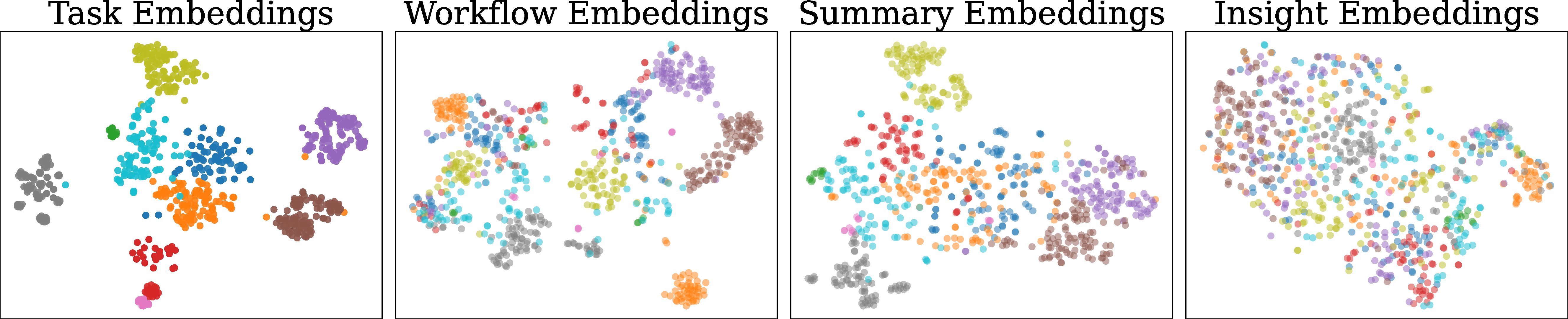
We visualize memory embedding spaces and quantify cluster structure across benchmarks to
verify that higher abstraction correlates with stronger transferability.
Figure 5. t-SNE of memory embeddings. Trajectory embeddings form
tight benchmark clusters; Insight embeddings are sparse and intermingled across benchmarks,
indicating stronger generalization (Figure 5).
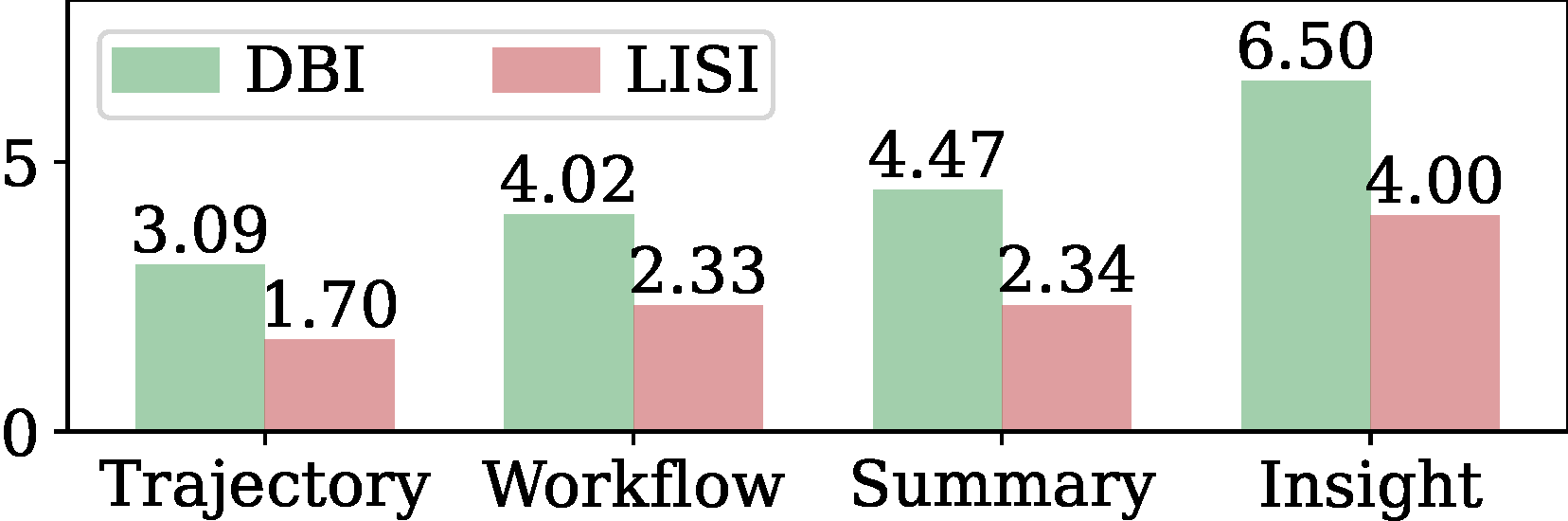
Figure 6 quantifies this separation with DBI and LISI: both metrics increase monotonically
from Trajectory to Insight, confirming a progressive transition toward benchmark-agnostic
representations. Table 3 provides causal evidence: within Insight memories, task-agnostic
ones outperform task-specific ones by +1.1% on average, showing that abstraction
itself drives transfer effectiveness.
Figure 6. Davies-Bouldin Index (DBI) and Local Inverse Simpson's
Index (LISI) across memory formats. Increasing DBI and LISI confirm a progressive
transition from task-specific to generalized representations.
Table 3. Causal analysis: within Insight memories, task-agnostic memories consistently outperform task-specific ones, confirming that abstraction — not format — drives transfer effectiveness.
Method
LCB
SWEB
RepliB
Avg.
Task-specific Insights
0.887
0.617
0.067
0.523
Task-agnostic Insights
0.893
0.627
0.082
0.534
Δ
+0.6%
+1.0%
+1.5%
+1.1%
Case Study: Trajectory vs. Insight
Trajectory memory causes the agent to blindly follow task-specific commands that fail in
a new environment. Insight memory provides abstract behavioral guidance, leading to success.
MTL with Trajectory Fail
MTL with Insight Success
Memory
From MLGym-Bench Task: Housing Price Prediction dataset + baseline...
Trajectory snippet: ls -la data && nl -ba evaluate.py | sed -n '1,240p' cat <<'PY' > train_predict.py ... OneHotEncoder(..., sparse=False) ... PY → TypeError: OneHotEncoder.__init__() got an unexpected keyword argument 'sparse'
From MLGym-Bench Title: Inspect eval requirements, combine train+val, use robust preprocessing, and adapt to library API changes
Description: Before improving a baseline model, read the repository/evaluation expectations, train on all available labeled data, apply robust preprocessing for numeric and categorical features...
Content: First inspect the code that loads labels and evaluates predictions so you know the exact submission format and metrics to optimize. For the final model, combine training...
Reasoning
I'll start by inspecting the repository root... I'll use Memory Item 1 as a reference for the initial steps of exploring the codebase. Blindly following the trajectory resulted in an execution error.
I will modify gradient_boosting.py to map encoded integer labels back to the original class labels before passing them to the scorer during early stopping... I'll use Memory Item 2 (inspect/evaluate and adapt code) as guidance to carefully inspect and modify the code.
Finding 3
More abstract and generalized memory representations yield higher transfer effectiveness
by avoiding brittle implementation anchoring.
Negative Transfer in MTL
MTL can occasionally degrade performance. We identify three primary failure modes:
Domain-mismatched Anchoring
Structurally irrelevant but superficially similar memories act as misleading anchors,
introducing incorrect assumptions.
False Validation Confidence
Verification memories create a false sense of certainty, leading to self-confirming
loops that miss formal success criteria.
Finding 4
Negative memory transfer mainly arises from domain-mismatched misleading anchors,
false validation signals, and misapplied procedural reuse.
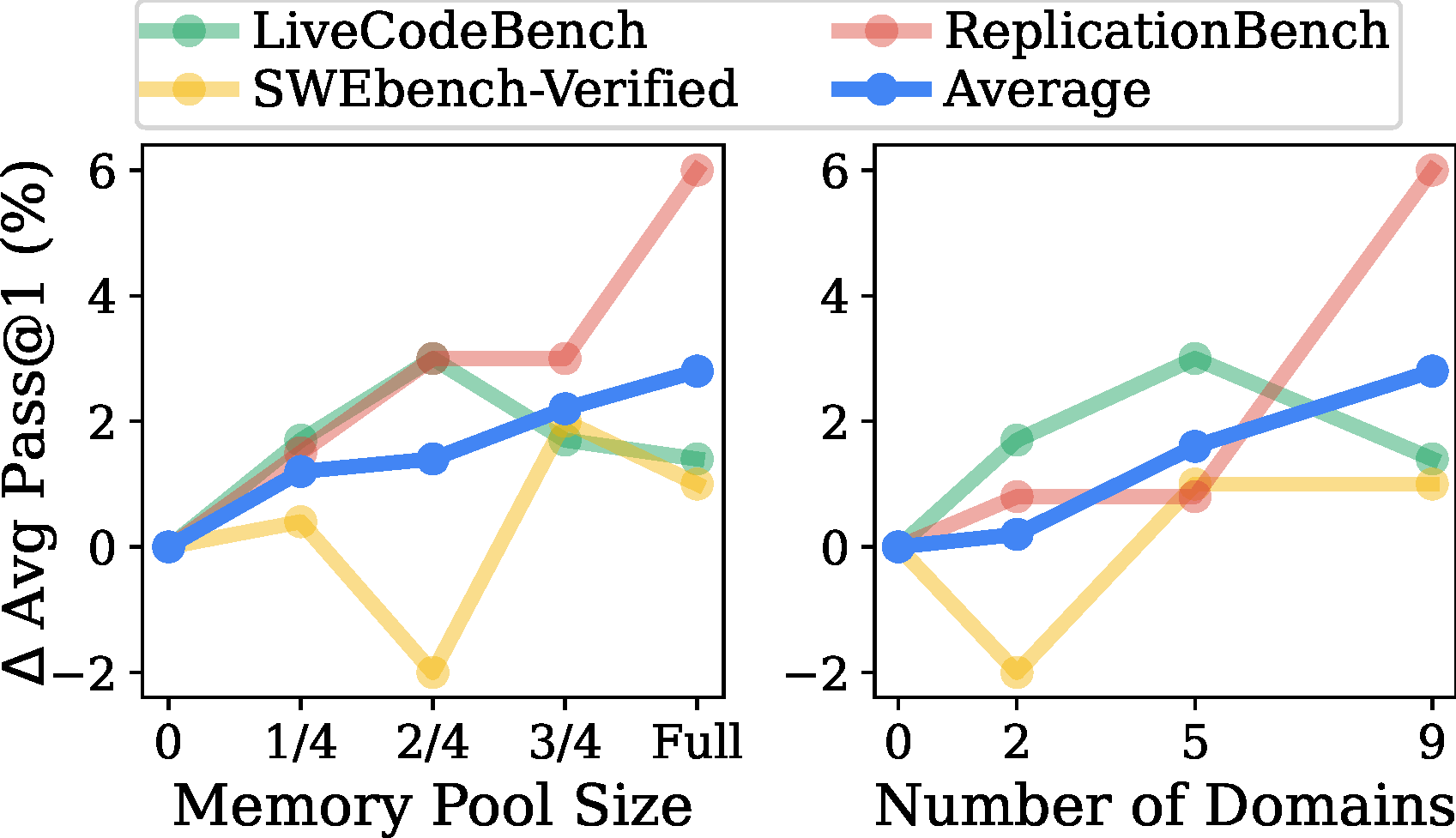
Transfer Scales with Pool Size and Domain Diversity
Larger and more diverse memory pools consistently lead to better performance, as they
increase the chance of retrieving genuinely useful meta-knowledge.
Figure 7. Performance of MTL as a function of memory pool size (left)
and number of source domains (right). Both axes show consistent improvement, with 9 domains
yielding the best results.
Finding 5
The effectiveness of Memory Transfer Learning scales with the size of the memory pool
and the number of source domains.
Cross-Model Memory Transfer
Since meta-knowledge is model-agnostic, memories generated by one model can benefit a
different model — in both directions (stronger→weaker and weaker→stronger).
Table 4. Average Pass@1 results of cross-model, cross-domain memory transfer. Cross-model transfer consistently outperforms zero-shot, while self-generated memories (source = target) yield the best results.
Memory Source
Target Model
LiveCodeBenchv6
SWEBench-Verified
ReplicationBench
Avg.
Target: GPT-5-mini
Zero-Shot
GPT-5-mini
0.863
0.623
0.059
0.515
DeepSeek V3.2
GPT-5-mini
0.890
0.617
0.048
0.518
Qwen3-Coder
GPT-5-mini
0.883
0.607
0.093
0.528
GPT-5-mini
GPT-5-mini
0.877
0.633
0.119
0.543
Target: DeepSeek V3.2
Zero-Shot
DeepSeek V3.2
0.890
0.423
0.144
0.486
GPT-5-mini
DeepSeek V3.2
0.890
0.450
0.163
0.501
DeepSeek V3.2
DeepSeek V3.2
0.893
0.463
0.178
0.511
Target: Qwen3-Coder
Zero-Shot
Qwen3-Coder
0.733
0.347
0.126
0.402
GPT-5-mini
Qwen3-Coder
0.780
0.347
0.111
0.413
Qwen3-Coder
Qwen3-Coder
0.740
0.370
0.130
0.413
Finding 6
Memory can be transferred across different models. Self-generated memories yield the
best performance, but cross-model transfer consistently beats the zero-shot baseline.
Cross-Domain Retrieval is Challenging
LLM-based reranking and task-adaptive memory rewriting did not outperform simple
embedding-based retrieval, suggesting that static retrieval methods designed for RAG
do not generalize to multi-step agentic settings.
Table 5. Pass@3 performance comparison across different memory retrieval methods. Simple embedding similarity outperforms both LLM reranking and adaptive rewriting, highlighting the difficulty of cross-domain retrieval in agentic settings.
Retrieval Method
LiveCodeBenchv6
SWEBench-Verified
ReplicationBench
Avg.
No Memory
0.910
0.730
0.111
0.584
LLM Reranking
0.920
0.730
0.144
0.598
Adaptive Rewriting
0.920
0.760
0.144
0.608
Embedding Similarity
0.930
0.770
0.189
0.630
Finding 7
Cross-domain memory retrieval is inherently challenging, and static retrieval methods
fail to generalize in heterogeneous agentic settings.
BibTeX
If you find this work useful, please cite:
@misc{kim2026memorytransferlearningmemories,
        title={Memory Transfer Learning: How Memories are Transferred Across Domains in Coding Agents},
        author={Kangsan Kim and Minki Kang and Taeil Kim and Yanlai Yang and Mengye Ren and Sung Ju Hwang},
        year={2026},
        eprint={2604.14004},
        archivePrefix={arXiv},
        primaryClass={cs.AI},
        url={https://arxiv.org/abs/2604.14004},
  }